The Automated Hotel: Revolutionizing Hospitality with Smart Technology and Robotics
Explore the transformative power of hotel automation, from smart rooms and contactless check-in to robotic services and AI-driven operations. This in-depth analysis covers key technologies, real-world case studies, ROI considerations, and future trends shaping the hospitality landscape.
Automazione
Redazione World Hotel Journal
# The Automated Hotel: Revolutionizing Hospitality with Smart Technology and Robotics
The hospitality industry stands at the precipice of a technological revolution, driven by the relentless pursuit of efficiency, enhanced guest experiences, and operational resilience. At the heart of this transformation lies hotel automation, a multifaceted approach integrating advanced technologies to streamline operations, personalize services, and optimize resource management. From the moment a guest considers a stay to their final departure, automation is reshaping every touchpoint, promising a future where convenience, customization, and sustainability converge.
This comprehensive exploration delves into the core components of hotel automation, examining the pivotal role of IoT, the evolution of contactless check-in, the rise of robotic services, and the overarching impact of intelligent software. We will dissect real-world applications, analyze the financial implications, and peer into the crystal ball to forecast the trends that will define the automated hotel of 2026 and beyond.
## The Dawn of Hotel Automation: A Strategic Imperative
Hotel automation is no longer a futuristic concept; it is a present-day reality and a strategic imperative for properties aiming to remain competitive and relevant. In an era defined by evolving guest expectations, labor shortages, and the demand for seamless, personalized experiences, automation offers a compelling solution. It encompasses a broad spectrum of technologies, from simple task automation to complex AI-driven systems, all designed to reduce manual intervention, improve service delivery, and enhance operational intelligence.
The primary drivers for adopting hotel automation include:
* **Enhanced Guest Experience:** Providing faster, more convenient, and personalized services.
* **Operational Efficiency:** Reducing labor costs, minimizing errors, and optimizing resource allocation.
* **Revenue Optimization:** Dynamic pricing, upsell opportunities, and improved guest satisfaction leading to repeat business.
* **Data-Driven Insights:** Collecting and analyzing data to inform strategic decisions and predict trends.
* **Sustainability:** Optimizing energy consumption and reducing waste through intelligent systems.
* **Resilience:** Adapting to unforeseen challenges, such as pandemics, by enabling contactless interactions.
### The Foundational Role of Connectivity: IoT and Smart Rooms
At the core of modern hotel automation lies the Internet of Things (IoT). IoT devices – physical objects embedded with sensors, software, and other technologies – connect and exchange data over the internet, forming an intelligent network within the hotel. In a smart hotel, IoT transforms guest rooms into personalized, responsive environments and empowers management with unprecedented control over building infrastructure.
#### Smart Room Technology: Personalization at Your Fingertips
Smart rooms leverage IoT to offer guests unparalleled control over their environment, enhancing comfort and convenience. Imagine a room that anticipates your preferences, adjusts lighting based on natural daylight, and sets the temperature to your ideal comfort level before you even arrive.
**Key Smart Room Features:**
* **Automated Lighting and Climate Control:** Guests can manage lighting scenes, blinds, and thermostat settings via in-room tablets, mobile apps, or voice commands. Occupancy sensors can automatically adjust settings when a room is vacant, saving energy.
* *Example: Hilton's 'Connected Room' technology allows guests to control lights, temperature, and TV from their Hilton Honors app or an in-room device, and even personalize their streaming content.*
* **Voice-Activated Assistants:** Devices like Amazon Echo or Google Home integrate with room systems, allowing guests to request services, control amenities, or get local information simply by speaking.
* *Example: Marriott International has piloted voice assistants in select properties, enabling guests to ask for fresh towels, control entertainment, or set wake-up calls.*
* **Smart Entertainment Systems:** Seamless integration of personal devices for streaming, casting content to the TV, and accessing hotel services through an intuitive interface.
* **Personalized Minibar and Services:** Sensors can track minibar consumption, automatically billing guests and alerting staff for replenishment. AI can suggest personalized minibar items based on guest preferences.
* **Predictive Maintenance:** IoT sensors in appliances (HVAC, refrigerators) can detect potential issues before they become critical failures, allowing for proactive maintenance and minimizing guest disruption.
#### Beyond the Room: Building-Wide IoT Integration
IoT extends beyond individual guest rooms to optimize entire hotel operations. This includes smart locks, intelligent waste management systems, and connected kitchen equipment, all contributing to a more efficient and responsive property.
## Contactless Check-In: The New Standard for Guest Arrival
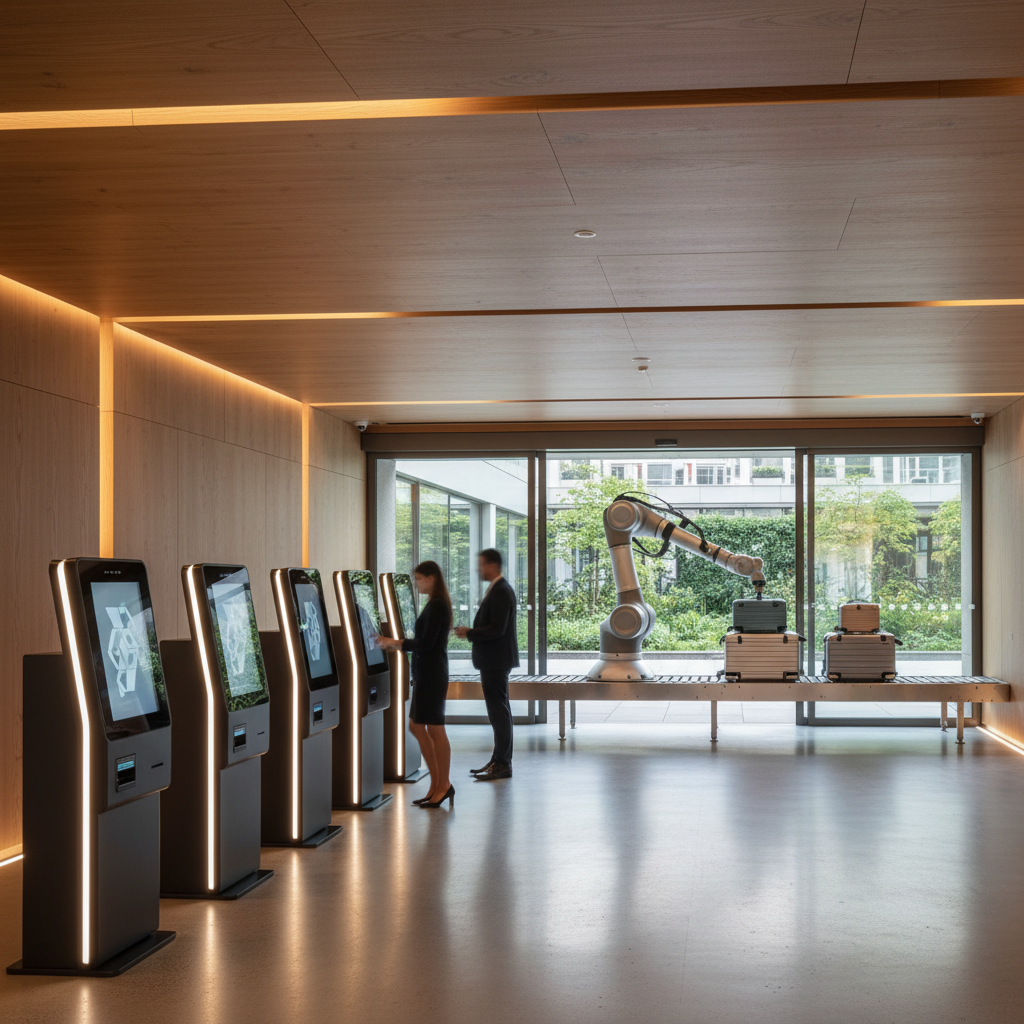
The pandemic significantly accelerated the adoption of contactless technologies, transforming what was once a convenience into a fundamental expectation. Contactless check-in systems minimize physical interaction, reduce wait times, and empower guests with greater control over their arrival experience.
### Hotel Self Check-In System: Kiosks and Mobile Apps
Self check-in systems are rapidly replacing traditional front desk interactions, offering speed and autonomy.
#### Kiosk-Based Check-In
* **Functionality:** Guests can check in, select rooms, receive digital or physical key cards, and even pay for their stay using an intuitive touchscreen interface. Some advanced kiosks can handle passport scanning and identity verification.
* **Benefits:** Reduces front desk queues, frees up staff for more personalized guest interactions, and offers 24/7 check-in capabilities.
* *Example: YOTEL, known for its 'cabin' concept, has long utilized self check-in kiosks, allowing guests to retrieve key cards and manage their stay efficiently, embodying a tech-forward approach.*
#### Mobile Check-In and Mobile Key
* **Functionality:** Guests can check in via a hotel's mobile app before arrival, receive a digital room key on their smartphone, and bypass the front desk entirely. The mobile key uses technologies like Bluetooth Low Energy (BLE) or Near Field Communication (NFC) to unlock doors.
* **Benefits:** Ultimate convenience for guests, reduces physical touchpoints, and offers opportunities for personalized upsells and communication through the app.
* *Example: Hilton's Digital Key, accessible through the Hilton Honors app, allows guests to select their room, check in, and unlock their door using their smartphone across thousands of properties worldwide.*
### Facial Recognition for Seamless Access
While still emerging due to privacy concerns and regulatory landscapes, facial recognition technology holds immense potential for ultra-seamless guest experiences.
* **Functionality:** Upon arrival, guests who have opted in can be recognized by cameras, allowing for instant check-in confirmation and keyless entry to their room and other hotel facilities. This can also extend to personalized greetings and service delivery.
* **Benefits:** Eliminates the need for physical keys or cards, offers unparalleled speed, and enhances security.
* *Example: FlyZoo Hotel by Alibaba in Hangzhou, China, is a pioneering example, using facial recognition for check-in, elevator access, and even ordering food at the restaurant, showcasing a truly futuristic guest journey.*
## Hotel Robot Service: The Rise of the Robotic Workforce
Robots are no longer confined to manufacturing plants; they are increasingly becoming integral members of hotel teams, performing a variety of tasks from delivering amenities to cleaning and concierge services. These 'cobots' (collaborative robots) work alongside human staff, augmenting their capabilities and enhancing service delivery.
### Room Service and Delivery Robots
* **Functionality:** Autonomous mobile robots (AMRs) navigate hotel corridors using sophisticated mapping and obstacle avoidance technology to deliver towels, toiletries, food, and beverages directly to guest rooms. Guests can place orders via in-room tablets or mobile apps.
* **Benefits:** Provides 24/7 service without requiring human staff, reduces labor costs, and offers a novel, engaging experience for guests.
* *Example: Savioke's 'Relay' robot, commonly known as 'Botlr', has been deployed in numerous hotels like the Crowne Plaza San Jose-Silicon Valley and Hotel EMC2 in Chicago, delivering items to guest rooms efficiently and charmingly.*
### Cleaning and Housekeeping Robots
* **Functionality:** Robotic vacuum cleaners, floor scrubbers, and even UV-C disinfection robots are being deployed to maintain cleanliness standards, particularly in large public areas and during off-peak hours. Some advanced robots can even clean bathrooms.
* **Benefits:** Improves cleaning consistency, reduces the physical burden on human staff, and can operate during quiet hours, ensuring pristine conditions for guests.
* *Example: The Henn-na Hotel in Japan, renowned for its robot staff, utilizes robotic vacuums and other automated cleaning solutions to maintain its premises. More broadly, companies like Brain Corp provide autonomous cleaning robots for large commercial spaces, including hotels.*
### Concierge and Front Desk Robots
* **Functionality:** While not fully replacing human concierges, these robots can provide basic information, answer frequently asked questions, offer directions, and even check guests in. They often feature interactive screens and voice capabilities.
* **Benefits:** Provides instant information, reduces wait times, and offers a unique novelty factor.
* *Example: The aforementioned Henn-na Hotel features robotic dinosaurs and humanoid robots at its front desk, handling check-ins and providing information in multiple languages, albeit with human oversight.*
### Security and Surveillance Robots
* **Functionality:** Autonomous security robots patrol hotel premises, monitoring for suspicious activity, detecting anomalies, and providing real-time alerts to human security personnel. They can be equipped with cameras, thermal sensors, and even two-way communication.
* **Benefits:** Enhances security coverage, acts as a visible deterrent, and reduces the need for constant human patrols in certain areas.
## Automation Software: The Brains Behind the Operation
While hardware like IoT devices and robots capture attention, the true power of hotel automation lies in the sophisticated software systems that integrate, manage, and optimize all these components. These platforms act as the central nervous system, ensuring seamless operation and data flow.
### Property Management Systems (PMS) and Central Reservation Systems (CRS)
* **Evolution:** Modern PMS and CRS are no longer just booking and billing tools. They are integrated hubs that connect with various automation systems, from check-in kiosks to smart room controls. Cloud-based PMS solutions offer real-time data access, scalability, and enhanced security.
* **Functionality:** Automate reservation management, guest profiles, billing, housekeeping assignments, and maintenance requests. Integration with CRM systems allows for highly personalized guest communication and marketing.
### Revenue Management Systems (RMS)
* **Functionality:** AI-driven RMS analyze vast amounts of data – market demand, competitor pricing, historical booking patterns, local events, and even weather forecasts – to dynamically adjust room rates in real-time, maximizing occupancy and average daily rate (ADR).
* **Benefits:** Optimizes pricing strategies far beyond human capabilities, leading to significant revenue uplift.
* *Example: Solutions from companies like Duetto and IDeaS Revenue Solutions are widely adopted, helping hotels achieve optimal pricing strategies through sophisticated algorithms.*
### Customer Relationship Management (CRM) and Guest Messaging Platforms
* **Functionality:** Automate personalized communication with guests before, during, and after their stay. This includes automated pre-arrival emails with check-in instructions, in-stay messaging for service requests, and post-stay feedback surveys. AI-powered chatbots can handle routine inquiries 24/7.
* **Benefits:** Enhances guest engagement, improves satisfaction, and drives loyalty through targeted communication.
### Workforce Management and Task Automation
* **Functionality:** Software solutions automate staff scheduling, task assignments (e.g., housekeeping room cleaning order based on check-out times), and performance tracking. This includes predictive analytics to forecast staffing needs based on occupancy and event schedules.
* **Benefits:** Optimizes labor utilization, reduces administrative burden, and ensures efficient task completion.
## Energy Management Systems: Sustainable Automation
Beyond guest experience and operational efficiency, automation plays a critical role in achieving sustainability goals and reducing operational costs through intelligent energy management.
* **Functionality:** Integrated energy management systems (EMS) use IoT sensors to monitor and control HVAC, lighting, and other electrical loads across the property. They can detect occupancy, adjust settings based on real-time energy prices, and integrate with weather forecasts.
* **Benefits:** Significant reduction in energy consumption and utility bills, lower carbon footprint, and compliance with environmental regulations.
* *Example: Major hotel chains like Accor and IHG are implementing sophisticated EMS across their portfolios, using data analytics to identify inefficiencies and automate energy-saving protocols in unoccupied rooms and public areas.*
## Real-World Case Studies: Automation in Action
Examining specific examples provides a clearer picture of how hotels are successfully integrating automation.
### Case Study 1: The CitizenM Hotel Chain – A Pioneer in Contactless and Smart Design
CitizenM has built its entire brand around a tech-forward, automated guest experience. From the moment guests step into the lobby, they are greeted by self check-in kiosks where they can complete their arrival process in under a minute. Rooms are controlled via an in-room tablet (the 'MoodPad') or the CitizenM app, allowing guests to adjust lighting, temperature, blinds, and entertainment. There's no traditional front desk; instead, 'Ambassadors' are available to assist with more complex queries, freeing them from transactional tasks.
* **Key Takeaways:** CitizenM demonstrates that automation can be central to a brand's identity, enhancing efficiency while maintaining a high level of guest satisfaction through empowered and available staff for personalized interactions.
### Case Study 2: Hotel EMC2, Chicago – Blending Art, Science, and Robotics
Hotel EMC2, part of the Marriott Autograph Collection, is a prime example of integrating robotics for guest delight. The hotel employs two Savioke 'Relay' robots, named Cleo and Jett, to deliver amenities like towels, toiletries, and even snacks to guest rooms. These robots navigate the hotel autonomously, call elevators, and notify guests upon arrival. The hotel also features smart room technology and a sophisticated design that celebrates innovation.
* **Key Takeaways:** Robots can be more than just functional; they can be a unique brand differentiator and a source of positive guest engagement and memorable experiences.
### Case Study 3: Hilton's Connected Room Initiative – Scalable Smart Technology
Hilton's 'Connected Room' is a proprietary technology platform designed to bring smart room capabilities to its vast portfolio. Guests can control various in-room features – lighting, temperature, TV – directly from the Hilton Honors app on their smartphone or an in-room remote. The system is designed to learn guest preferences over time, offering a more personalized experience with each stay. This initiative is being rolled out across thousands of properties, demonstrating automation at scale.
* **Key Takeaways:** Large hotel chains can implement sophisticated automation solutions across diverse brands and properties, leveraging mobile apps as the central control hub for guests, and gathering valuable data on guest preferences.
## Costs and Return on Investment (ROI) of Hotel Automation
The initial investment in hotel automation can be substantial, but the long-term ROI is often compelling, driven by a combination of cost savings, revenue generation, and enhanced brand reputation.
### Initial Investment Considerations
* **Hardware:** Self check-in kiosks (USD 5,000 - 20,000+ per unit), smart locks (USD 100 - 500+ per door), IoT sensors (USD 50 - 500+ per device), robots (USD 20,000 - 100,000+ per unit, often leased), smart room controllers (USD 500 - 2,000+ per room).
* **Software:** Licensing fees for PMS, RMS, CRM, energy management systems, and integration platforms (can range from hundreds to thousands per month, or significant upfront costs for perpetual licenses).
* **Installation and Integration:** Costs associated with wiring, network infrastructure upgrades, and integrating disparate systems.
* **Training:** Staff training on new technologies and operational procedures.
### Calculating ROI: Key Metrics
ROI for hotel automation is multifaceted and can be measured through several key performance indicators (KPIs):
* **Labor Cost Reduction:** Automation reduces the need for human intervention in routine tasks (e.g., check-in, room service delivery, basic cleaning), leading to savings in wages, benefits, and recruitment.
* *Example: A hotel implementing self check-in kiosks might reduce front desk staffing by 1-2 FTEs per shift, leading to annual savings of tens of thousands of dollars per position.*
* **Energy Savings:** Smart energy management systems can reduce utility bills by 10-30% or more, translating into significant annual savings for large properties.
* **Increased Revenue:** Dynamic pricing from RMS, personalized upsell opportunities through mobile apps, and enhanced guest satisfaction leading to higher repeat bookings and positive reviews can boost ADR and RevPAR.
* **Improved Efficiency:** Faster check-in/check-out times, quicker response to guest requests (via robots or automated systems), and streamlined housekeeping operations contribute to overall operational efficiency.
* **Enhanced Guest Satisfaction & Loyalty:** A seamless, personalized, and convenient experience leads to higher guest satisfaction scores (e.g., NPS, TripAdvisor ratings), which directly impacts reputation and future bookings.
* **Reduced Maintenance Costs:** Predictive maintenance through IoT sensors can prevent costly equipment failures and extend asset lifespan.
* **Competitive Advantage:** Being an early adopter or leader in automation can attract tech-savvy travelers and differentiate the property in a crowded market.
*A typical payback period for significant automation investments can range from 18 months to 5 years, depending on the scale of implementation and the specific technologies adopted.*
## The Future of Hospitality: 2026 Trends in Hotel Automation
The pace of technological innovation shows no signs of slowing. By 2026, hotel automation will have evolved significantly, becoming even more integrated, intelligent, and guest-centric.
### Hyper-Personalization Driven by AI and Data Analytics
* **Predictive Guest Journeys:** AI will move beyond simple preferences to predict guest needs and desires even before they arise. This could mean pre-stocking minibars with preferred items, suggesting local activities based on past behavior, or proactively addressing potential issues.
* **AI-Powered Concierge:** Advanced AI will handle complex guest inquiries, provide highly tailored recommendations, and even engage in natural language conversations, making human-like interactions more common.
* **Dynamic Room Configuration:** Rooms will dynamically adjust based on guest profiles – for example, configuring lighting for a business traveler's work needs or setting a calming ambiance for a leisure guest.
### Advanced Robotics and Autonomous Operations
* **Multi-functional Robots:** Robots will become more versatile, capable of performing a wider range of tasks, from delivering luggage to assisting with minor repairs or even basic food preparation in limited-service settings.
* **Back-of-House Automation:** Expect to see more automation in laundry services, inventory management, and kitchen operations, further streamlining behind-the-scenes processes.
* **Autonomous Cleaning Fleets:** Entire fleets of cleaning robots will work collaboratively, autonomously managing cleaning schedules and adapting to real-time occupancy.
### Seamless and Invisible Technology
* **Biometric Everywhere:** Beyond facial recognition, voice recognition and even gait analysis might be used for seamless access and personalized services, all with robust privacy safeguards.
* **Ambient Computing:** Technology will become less visible and more integrated into the environment, responding intuitively to guest presence and needs without explicit commands.
* **Digital Twins:** Hotels will increasingly create 'digital twins' – virtual replicas of their physical properties – to simulate operations, predict maintenance needs, and optimize energy usage in real-time.
### Enhanced Sustainability through AI and Automation
* **Predictive Energy Optimization:** AI will not only react to current conditions but predict future energy needs based on weather, occupancy forecasts, and event schedules, allowing for proactive adjustments.
* **Waste Management Optimization:** Automated systems will sort waste, monitor consumption patterns, and provide insights to reduce food waste and other environmental impacts.
### The Human Touch Reimagined
Crucially, automation will not eliminate the need for human interaction but rather elevate it. By offloading mundane and repetitive tasks to technology, hotel staff will be free to focus on high-value interactions, providing genuine hospitality, solving complex problems, and creating truly memorable experiences that technology cannot replicate. The 'human touch' will become more intentional, personalized, and impactful.
## Conclusion: The Automated Hotel – A Future of Intelligent Hospitality
The journey towards the automated hotel is an ongoing evolution, driven by innovation and a commitment to excellence. From the foundational elements of IoT and smart rooms to the cutting-edge applications of contactless check-in and hotel robot service, automation is redefining every facet of hospitality. It promises a future where operational efficiency, personalized guest experiences, and sustainable practices are not just aspirations but achievable realities.
For hoteliers, embracing this technological shift is not merely about adopting new gadgets; it is about strategically integrating solutions that align with their brand vision, enhance guest value, and secure a competitive edge. The automated hotel of 2026 will be more intelligent, more responsive, and more capable of delivering the extraordinary experiences that modern travelers demand, all while empowering its human workforce to focus on the art of true hospitality. The future of hotels is automated, and it is bright.