The AI Hotel: How Artificial Intelligence is Transforming the Hospitality Industry in 2026
From smart rooms and predictive pricing to AI concierges and autonomous operations, artificial intelligence is fundamentally reshaping every aspect of the hotel industry. With 82% of hoteliers expanding AI investment in 2026, the question is no longer whether to adopt AI, but how fast you can implement it before your competitors do.
AI per Hotel
World Hotel Journal Editorial
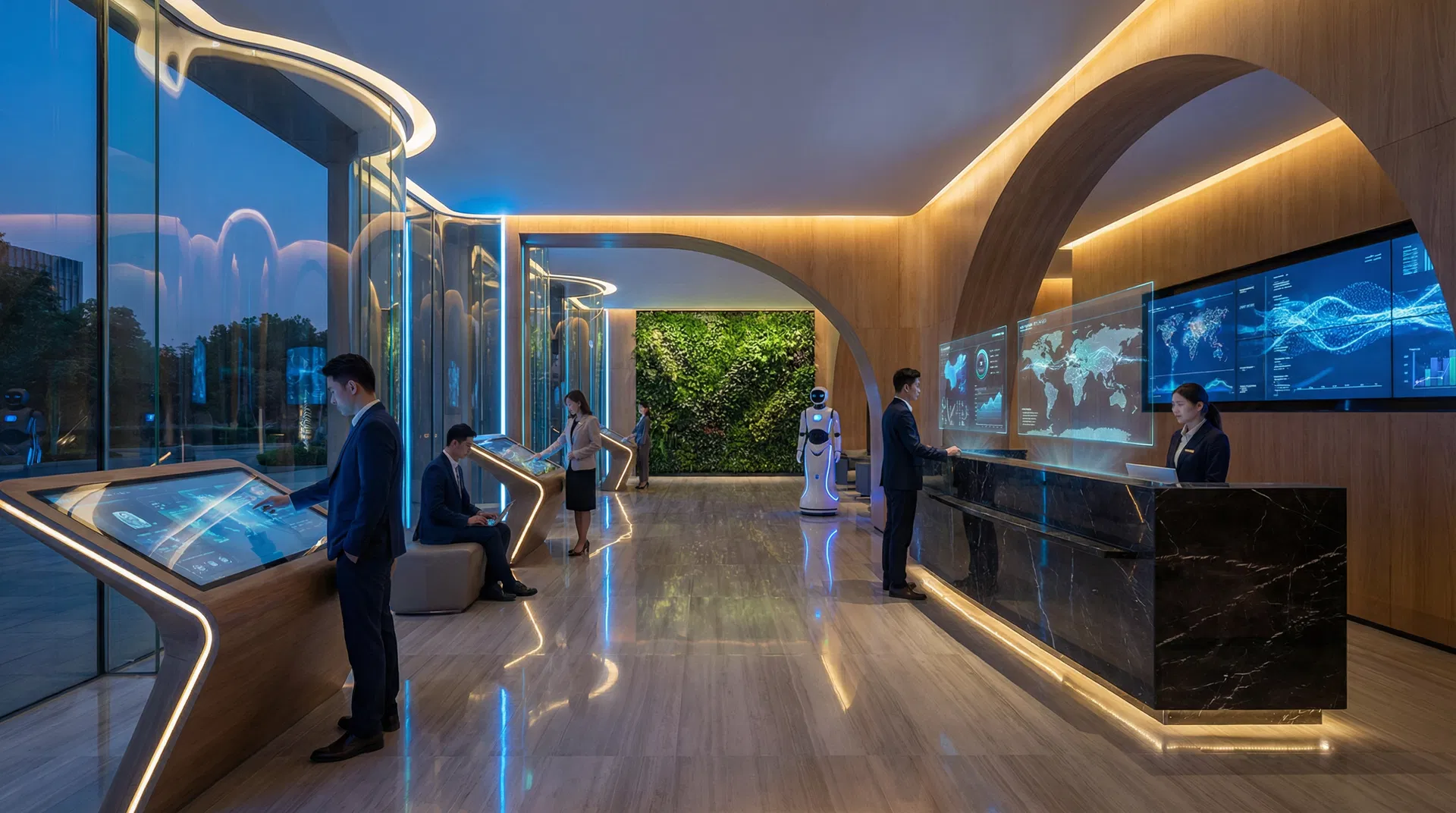
## Why Artificial Intelligence is the Biggest Revolution in Hospitality
The hospitality industry is experiencing its most profound technological transformation since the advent of online booking. **Artificial intelligence** is no longer a futuristic concept discussed at industry conferences—it is a present reality that is fundamentally reshaping how hotels operate, compete, and deliver guest experiences. According to a landmark report published by Canary Technologies in March 2026, **82% of hoteliers are actively expanding their AI investments** this year, signaling an industry-wide inflection point that will separate market leaders from those left behind.
The numbers tell a compelling story. The global AI in hospitality market, valued at approximately $1.2 billion in 2024, is projected to reach **$2.28 billion by 2030**, growing at a staggering compound annual growth rate of 57.7%, according to The Business Research Company. More than half of hoteliers (58%) now plan to devote upwards of **10% of their entire IT budget to AI** in 2026, up significantly from previous years. The top priorities driving this investment are improving the guest experience (52%), increasing operational efficiencies (52%), boosting revenue (51%), and reducing costs (45%).
Perhaps most telling is the finding from Boston Consulting Group’s March 2026 report, “AI-First Hotels: Leaner, Faster, Smarter,” which revealed that **25% of hospitality firms have already reached the “AI-scaling” stage**—meaning they have an AI strategy that is producing real, measurable returns across multiple organizational activities. This is no longer about pilot programs and proof-of-concept experiments. This is about fundamental business transformation.
**Marriott International** has committed **$1.1 billion in total investment spending for 2026**, with **35-40% dedicated to digital transformation and AI** — approximately $385-440 million allocated to AI-powered systems including natural language search on its website and app, content optimization for AI discoverability, and cloud-native platforms designed to support next-generation guest services. Meanwhile, **Hilton** launched its beta generative AI-powered trip planner in March 2026, enabling travelers to discover and book hotels through conversational AI interfaces.
## How AI is Changing Hotel Booking and Guest Acquisition
The traditional hotel booking funnel is being completely reimagined by artificial intelligence. From the moment a potential guest begins researching their trip to the final confirmation, AI is creating faster, smarter, and more personalized pathways to conversion.
### AI Booking Assistants
The era of scrolling through endless search results is giving way to **conversational booking experiences**. AI booking assistants can understand natural language queries like “Find me a boutique hotel in Rome with a rooftop bar, under €250 per night, close to the Colosseum” and deliver precisely matched results in seconds. These systems learn from each interaction, continuously improving their recommendations based on guest preferences, booking history, and behavioral patterns.
According to BCG’s research, digital direct bookings reached **$262 billion in 2024**, nearly matching OTA transactions at $266 billion. This convergence is being accelerated by AI-powered direct booking tools that offer personalized experiences rivaling or exceeding what OTAs provide. Hotels that integrate their booking channels directly into AI search environments—enabling travelers to search, compare, and book without leaving the AI conversation—are capturing an increasing share of direct revenue.
### Chatbot Reservation Systems
Modern **hotel chatbot systems** have evolved far beyond simple FAQ responders. Today’s AI-powered chatbots handle complex reservation modifications, upsell room upgrades based on guest profiles, process special requests, and manage multi-room group bookings—all in real time and in multiple languages. According to the Canary Technologies report, **guest communications represent the highest area of AI impact** in 2026, with 58% of hoteliers identifying it as the primary use case.
The sophistication of these systems is remarkable. AI chatbots can now detect guest sentiment during conversations, escalate to human agents when emotional complexity requires it, and proactively offer solutions before problems are articulated. Hotels using advanced AI messaging platforms report **response times reduced by 90%** and guest satisfaction scores improved by 15-20%.
### Predictive Demand Forecasting
AI-powered **demand forecasting** is transforming how hotels anticipate and prepare for occupancy fluctuations. Machine learning models analyze vast datasets—including historical booking patterns, local event calendars, flight capacity data, weather forecasts, social media sentiment, and competitive pricing—to predict demand with unprecedented accuracy.
These predictive capabilities enable hotels to optimize staffing levels weeks in advance, adjust inventory allocation across distribution channels, and prepare operational resources precisely when they’re needed. The result is a dramatic reduction in both overstaffing costs and service quality gaps during peak periods.
## Smart Hotels: The Rise of Automated Guest Experiences
The concept of the **smart hotel** has evolved from a marketing buzzword to an operational reality. In 2026, IoT-enabled rooms, AI-powered personalization engines, and voice-controlled environments are creating guest experiences that were unimaginable just five years ago.
### Smart Rooms and IoT Technology
Modern **smart hotel rooms** represent a convergence of IoT sensors, AI algorithms, and guest preference data. Temperature, lighting, curtain positions, and entertainment systems adjust automatically based on individual guest profiles—learning and refining preferences with each stay. When a returning guest checks in, the room already knows their preferred temperature (21°C), lighting mood (warm amber), and morning alarm time (6:45 AM).
According to industry analysts, IoT-enabled rooms in 2026 go far beyond basic automation. **Interactive streaming platforms** allow guests to seamlessly access their personal entertainment accounts. Smart mirrors display weather, news, and personalized recommendations. In-room tablets serve as digital concierges, offering restaurant reservations, spa bookings, and local experience recommendations—all powered by AI that understands the guest’s preferences and travel context.
### Personalized Hotel Stays Powered by Data
**Hyper-personalization** represents the holy grail of modern hospitality, and AI is finally making it achievable at scale. By analyzing data from multiple touchpoints—booking behavior, on-property interactions, dining preferences, spa usage, social media activity, and loyalty program history—AI creates comprehensive guest profiles that enable truly individualized experiences.
A business traveler who always orders a double espresso at 7 AM finds it waiting at their door. A couple celebrating an anniversary receives a complimentary bottle of their preferred wine. A family with children discovers age-appropriate activities and dining options pre-loaded on their in-room entertainment system. These aren’t random acts of kindness—they’re **data-driven hospitality decisions** that create emotional connections and drive loyalty.
### Voice Assistants in Hotel Rooms
**Voice technology** is rapidly changing how hotel guests interact with properties. According to Phocuswire’s analysis of AI trends for 2026, voice-controlled room assistants are evolving from novelty features to essential service delivery tools. Guests can control every aspect of their room environment, request services, ask for local recommendations, and even check out—all through natural voice commands.
The latest generation of hotel voice assistants supports **multilingual interactions**, automatically detecting and switching to the guest’s preferred language. For international hotels, this eliminates language barriers that have traditionally limited service quality for non-native speakers. BCG notes that in economy and midscale properties, “agentic AI can remove substantial friction: automated biometric check-in, robot-delivered amenities, and multilingual AI concierges that respond instantly.”
## AI Revenue Management: The Future of Hotel Pricing
Revenue management has always been at the heart of hotel profitability, but AI is elevating it from an art to a precise science. The days of manually adjusting rates based on seasonal patterns and competitor benchmarks are rapidly giving way to **real-time, AI-driven dynamic pricing** that responds to market conditions in seconds.
### Dynamic Pricing Strategies
AI-powered **dynamic pricing engines** continuously analyze an extraordinary range of variables: booking pace, competitor rates, flight capacity to the destination, search trends, local events, brand sentiment from reviews and social media, and even weather forecasts. When a major concert is announced or airline capacity to a destination increases, rates and length-of-stay rules adjust automatically—reallocating inventory between OTAs and direct channels to maximize profit.
The impact is already measurable. According to hotel industry analysts STR, cited in BCG’s report, **AI-driven pricing optimizers have generated upward of 15% growth in Revenue per Available Room (RevPAR)** at properties that have fully implemented these systems. Hotels using AI for group displacement decisions see **up to 19% uplift in total revenue**, according to Hotel Technology News.
### Demand Prediction Algorithms
Modern **AI demand prediction** goes far beyond traditional forecasting models. Machine learning algorithms process hundreds of data signals simultaneously, identifying patterns and correlations that human revenue managers could never detect. These systems can predict demand shifts **72 to 96 hours before they materialize** in booking data, giving hotels a critical window to adjust pricing, staffing, and inventory strategies.
The sophistication extends to understanding **micro-segments** within the broader demand picture. AI can distinguish between price-sensitive leisure travelers, corporate bookers with fixed budgets, and high-value guests willing to pay premium rates for the right experience—and optimize pricing for each segment simultaneously.
### Real-Time Market Intelligence
**AI-powered market intelligence platforms** provide hotels with a continuous, 360-degree view of their competitive landscape. These systems monitor competitor pricing, review sentiment, social media mentions, and booking platform positioning in real time, generating actionable insights that inform both tactical pricing decisions and long-term strategic planning.
The integration of AI market intelligence with revenue management systems creates a **closed-loop optimization cycle**: market data feeds pricing algorithms, pricing decisions generate booking data, and booking outcomes refine the AI models. This continuous learning loop means that AI revenue management systems become more accurate and more profitable over time.
## Hotel Marketing in the AI Era
The intersection of **artificial intelligence and hotel marketing** is creating unprecedented opportunities for hotels to reach, engage, and convert potential guests with precision and efficiency that traditional marketing approaches cannot match.
### AI-Powered Advertising
AI is transforming hotel advertising from broad-reach campaigns to **hyper-targeted, personalized messaging** delivered at precisely the right moment in the traveler’s decision journey. Machine learning algorithms analyze browsing behavior, search patterns, and demographic data to identify potential guests with the highest conversion probability, then serve them customized creative content that resonates with their specific travel motivations.
The efficiency gains are substantial. Hotels using AI-optimized advertising report **30-40% improvements in cost per acquisition** compared to traditional digital marketing approaches, while simultaneously increasing booking quality and average daily rates.
### Guest Data and Personalization
The concept of the **Customer Data Platform (CDP)** has become central to AI-driven hotel marketing. These platforms aggregate guest data from every touchpoint—website visits, booking engine interactions, on-property behavior, loyalty program activity, email engagement, and social media interactions—creating unified guest profiles that power personalized marketing at every stage of the guest lifecycle.
Pre-arrival emails that recommend specific room types based on past preferences. Post-stay campaigns that suggest the guest’s next destination based on travel patterns. Loyalty offers calibrated to each member’s engagement level and lifetime value. This is the reality of **AI-powered hotel marketing** in 2026.
### Direct Booking Strategies
AI is proving to be the most powerful weapon in the battle for **direct bookings**. By analyzing the factors that drive guests to book directly versus through OTAs—price perception, loyalty benefits, booking experience quality, and trust signals—AI systems can dynamically adjust the direct booking proposition to maximize conversion.
BCG’s research highlights that brand equity in hospitality is shifting from name recognition to **algorithmic relevance**. To stay discoverable in AI-driven environments, hotel databases and content must be machine-readable and optimized for AI answer engines—whether on Google, OTAs, social platforms, or ChatGPT. Content needs to be broader and deeper, addressing both general questions (“Does the hotel offer breakfast?”) and specific ones (“Does breakfast offer vegan-friendly options?”).
## The Next Generation Hotel: What Hospitality Will Look Like by 2030
Looking beyond the immediate horizon, the convergence of AI, IoT, robotics, and data science is painting a picture of a hospitality industry that will be fundamentally different from what we know today.
### Hyper-Personalized Travel
By 2030, the concept of a “standard” hotel stay will be obsolete. Every aspect of the guest experience—from the room environment to dining recommendations, from activity suggestions to check-out timing—will be **individually calibrated** based on comprehensive AI-powered guest profiles. The hotel will know you better than you know yourself, anticipating needs before they’re expressed and creating moments of delight that feel spontaneous but are actually precisely engineered.
### Autonomous Hotel Operations
The **AI-first hotel** of 2030 will operate with a level of autonomy that dramatically reduces operational complexity while improving service consistency. BCG envisions hotels where “an automated back office gives hotel companies moment-to-moment visibility into conditions at properties across their network.” Energy management, inventory procurement, maintenance scheduling, and quality assurance will all be managed by AI systems that optimize continuously without human intervention.
Four Seasons Peninsula Papagayo is already demonstrating this future with AI waste-tracking tools like **Winnow**, which combines cameras and scales to monitor buffet leftovers and feeds real-time analytics back to the kitchen. Such tools have **cut food waste by approximately 50% within eight months**—a remarkable achievement that simultaneously reduces costs and advances sustainability goals.
### The Role of Data in Hospitality
Data will become the **most valuable asset** in the hospitality industry, surpassing even physical real estate in strategic importance. Hotels that build robust data infrastructure—capturing, analyzing, and acting on guest data across every touchpoint—will have an insurmountable competitive advantage. AI-powered location-intelligence platforms like MapZot.AI are already using traffic flows, demographic shifts, airport volumes, and zoning activity to score potential hotel sites and identify market opportunities.
## Conclusion: Hotels That Ignore AI Risk Disappearing
The evidence is overwhelming and the trajectory is clear. **Artificial intelligence is not a trend—it is the new foundation of competitive hospitality.** The Canary Technologies report shows that 82% of hoteliers are expanding AI use. BCG identifies AI as the driver of three fundamental transformations in hotel operations. Marriott is investing over $1 billion. Hilton is deploying generative AI trip planners.
Hotels that embrace AI today are building **compounding advantages** that will be nearly impossible for late adopters to overcome. Every AI-optimized booking, every personalized guest interaction, every dynamically priced room generates data that makes the system smarter, faster, and more profitable. This is not a linear improvement curve—it is an exponential one.
The question for every hotelier in 2026 is not whether AI will transform the industry. That transformation is already underway. The question is whether your hotel will be among those **leading the revolution** or among those struggling to survive in its wake.
---
**FAQ**
**What is AI in hospitality?**
AI in hospitality refers to the application of artificial intelligence technologies—including machine learning, natural language processing, computer vision, and predictive analytics—to improve hotel operations, guest experiences, revenue management, and marketing effectiveness.
**How much are hotels investing in AI in 2026?**
According to the Canary Technologies 2026 report, 85% of hospitality IT decision-makers will devote more than 5% of their IT budgets to AI, with 58% allocating upwards of 10%. Marriott International alone is investing over $1 billion in technology in 2026.
**What are smart hotel rooms?**
Smart hotel rooms use IoT sensors, AI algorithms, and guest preference data to automatically adjust temperature, lighting, entertainment, and other room features based on individual guest profiles. They include voice assistants, interactive streaming platforms, and digital concierge services.
**How does AI improve hotel revenue management?**
AI revenue management systems analyze hundreds of data signals—including booking pace, competitor rates, event calendars, and weather—to optimize pricing in real time. Hotels using AI-driven pricing have seen up to 15% growth in RevPAR and 19% uplift in total revenue.
**Will AI replace hotel staff?**
AI is designed to augment, not replace, hotel staff. In luxury properties, AI handles administrative tasks so staff can focus on creating deeper, personalized guest experiences. In economy properties, AI automates routine processes like check-in and basic service requests, allowing staff to focus on higher-value interactions.