The Personalization Gap: A $115 Billion Opportunity
The hospitality industry stands at a pivotal crossroads. According to a landmark study by Medallia, 61% of consumers are willing to spend more for customized experiences, yet only 23% of hotel stays are currently rated as "highly personalized." This staggering gap represents not just a missed opportunity — it's a $115 billion revenue potential that the most forward-thinking hotel groups are now racing to capture through predictive artificial intelligence.
In 2026, the conversation has shifted decisively from whether hotels should adopt AI-driven personalization to how quickly they can implement it. As Boston Consulting Group's landmark report "AI-First Hotels: Leaner, Faster, Smarter" reveals, fewer than 10% of hospitality companies qualify as "future built" with cutting-edge AI capabilities, while 25% have entered the "AI-scaling" phase — generating real returns across multiple organizational activities.
Unified Guest Intelligence: The Foundation of Everything
The era of fragmented guest data is ending. The most significant technological shift in hospitality personalization is the emergence of Unified Guest Intelligence Platforms — systems that connect every data source into a single, dynamic guest profile. As Saurabh Goel, VP at Astound Digital, explains: "True hyper-personalization begins when you stop treating each touchpoint as an isolated interaction and start seeing the complete guest journey."
These platforms aggregate data from booking history, loyalty programs, social media activity, in-stay behavior, room service orders, spa preferences, and even IoT sensor data from smart rooms. The result is a living profile that evolves with every interaction. When a returning guest books a room, the system already knows they prefer a corner room on a high floor, request extra pillows, enjoy a specific wine at dinner, and typically book spa treatments on their second day.
Marriott International's proprietary AI platform now processes over 170 million member profiles, cross-referencing stay history with real-time behavioral signals to generate what the company calls "anticipatory service recommendations." The system can predict with 89% accuracy whether a guest will request late checkout, order room service, or visit the fitness center — before they even arrive at the property.
Predictive Analytics: Anticipating Needs Before Arrival
Predictive AI in hospitality has evolved far beyond simple recommendation engines. Modern systems analyze patterns across millions of stays to identify subtle behavioral signals that human staff would never detect. For example, AI can recognize that a guest who books a suite for a weekend in March, combined with their browsing history of local fine-dining restaurants, is likely celebrating an anniversary — triggering a cascade of personalized touches from champagne upon arrival to a pre-arranged dinner reservation.
According to BCG's research, 37% of travelers now use AI large language models embedded in online travel sites to plan and book trips. These AI assistants generate custom itineraries instantly, tailored to preferences and budgets. As users connect their social media activity and online behaviors, the tools continuously learn and refine, delivering ever-more personalized recommendations.
IHG Hotels & Resorts has deployed predictive housekeeping models that anticipate peak cleaning times and allocate resources accordingly. The system analyzes check-out patterns, guest preferences, and historical data to optimize room preparation schedules. Meanwhile, the Ritz-Carlton San Francisco implemented an AI system that synchronizes room-cleaning schedules with check-out patterns, guest preferences, and staff availability — speeding up room preparation by 20% while simultaneously improving guest satisfaction scores.
Real-Time Personalization During the Stay
The most transformative application of predictive AI occurs during the guest's stay itself. Modern AI systems monitor real-time signals — room service orders, app interactions, thermostat adjustments, lighting preferences — to continuously refine the guest experience. If a guest orders chamomile tea at 10 PM, the system learns this as a nighttime ritual. If they adjust the room temperature to 19°C every evening, the system pre-sets it for subsequent nights.
Oracle Hospitality's 2026 survey found that 77% of respondents are interested in automated messaging and chatbot services during their stay. But the real breakthrough isn't reactive chatbots — it's proactive AI that detects potential dissatisfaction before the guest even complains. If a guest who typically rates stays 9/10 suddenly shows reduced engagement with hotel amenities, the system alerts front desk staff to intervene with a personalized gesture.
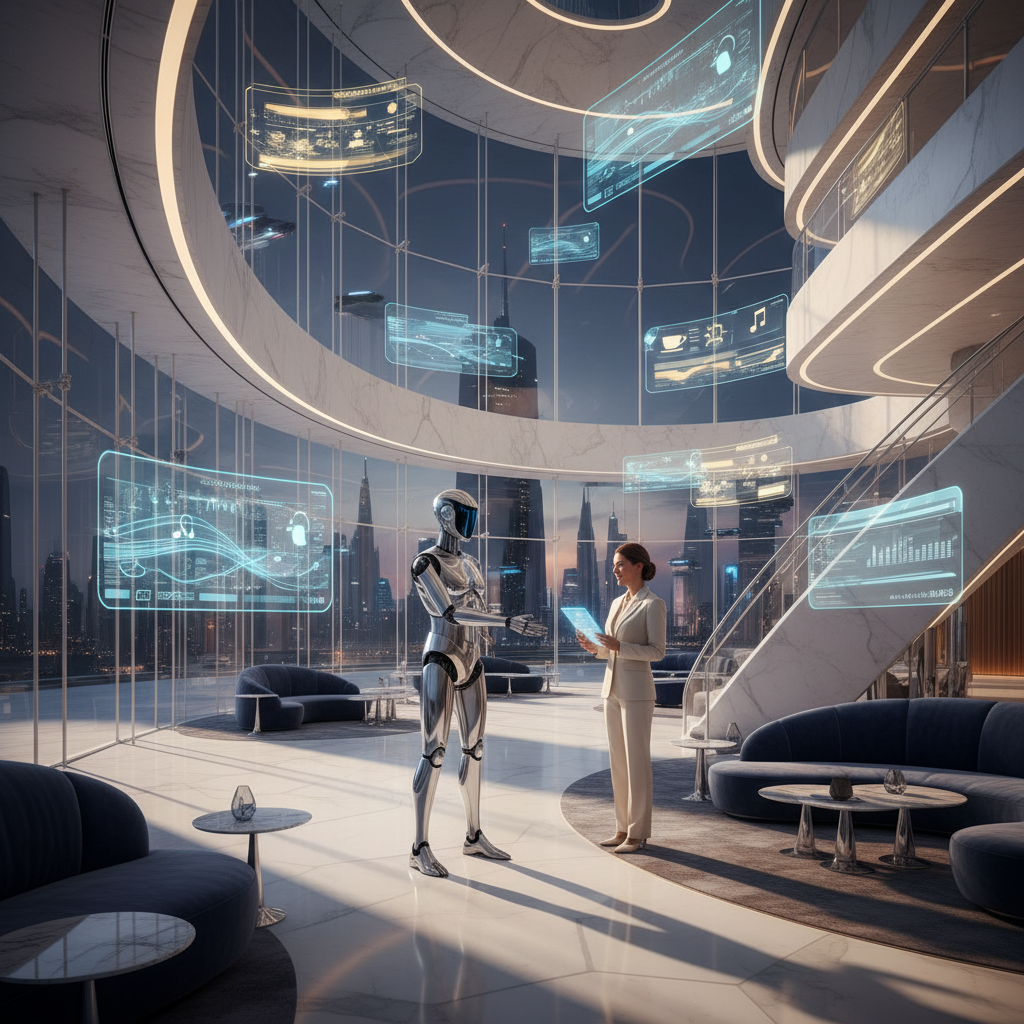
The Otonomus Hotel in Las Vegas, which opened in late 2025 as the world's first fully AI-powered hotel, takes this concept to its extreme. Every aspect of the guest experience — from check-in to room environment to dining recommendations — is managed by an integrated AI system that learns and adapts in real time. Robot concierges named "Oto" greet guests, while AI-powered room systems adjust lighting, temperature, and entertainment based on individual preferences.
Voice Technology: The Quiet Revolution
Voice technology is emerging as a critical interface for personalized guest experiences. As Sebastien Leitner of Cloudbeds notes in his analysis of 2026 hotel technology trends, advances in large language models have transformed voice systems from basic command-response tools into sophisticated conversational interfaces that understand intent, handle follow-up questions, and support multi-step requests.
Guests can now book spa treatments, request specific room configurations, order meals with dietary modifications, and explore local recommendations — all through natural conversation. Hotels that have implemented hospitality-specific voice platforms report 34% higher guest satisfaction scores compared to properties using generic consumer voice assistants.
The key differentiator is contextual awareness. A hospitality-trained voice system understands that "I'd like something quiet for dinner" in a Lake Como resort means a different recommendation than the same request in a Tokyo business hotel. Combined with the guest's profile data, voice AI can deliver recommendations that feel genuinely personal rather than algorithmically generic.
AI-Driven Dynamic Pricing: Personalization Meets Revenue
Hyper-personalization extends beyond the guest experience into the commercial realm. AI-powered revenue management systems now adjust prices in seconds, accounting for supply and demand, competitor moves, booking pace, event calendars, and sentiment data from reviews and social media. According to STR data cited by BCG, AI-driven pricing optimizers have generated upward of 15% growth in Revenue Per Available Room (RevPAR) at properties that have fully implemented them.
But the most sophisticated systems go further, offering personalized pricing based on individual guest value. A loyal guest who consistently books suites and utilizes premium amenities might receive a different rate structure than a first-time visitor. This isn't simple discounting — it's AI-calculated lifetime value optimization that considers the guest's total spending pattern, referral potential, and brand advocacy likelihood.
Modern forecasting engines, as Phocuswire reports, can achieve approximately 96% accuracy compared to an industry norm closer to 82%. This gap compounds across every automated decision — from pricing to staffing levels to inventory allocation and marketing spend.
Workforce Augmentation: AI as the Empathy Amplifier
The hospitality industry faces an unprecedented labor crisis. According to the American Hotel & Lodging Association, 65% of North American hotels reported staffing shortages in 2025, while labor costs jumped 11.2% year-over-year. Predictive AI is emerging not as a replacement for human staff but as a powerful augmentation tool that allows fewer employees to deliver more personalized service.
Hilton's "Connie" robot concierge and Marriott's fleet of text-based chatbots handle routine requests — Wi-Fi credentials, late checkouts, room transfers — freeing human staff to focus on the high-touch interactions that create emotional connections. According to Statista, 65% of global travel leaders believe the most impactful implementation of generative AI relates to chatbots, virtual assistants, and customer service.
Adaptive staff development platforms represent what Cloudbeds calls "the overlooked game changer." These systems continuously adapt training and guidance based on how each staff member works, delivering just-in-time training precisely when and how each employee needs it. The result is a workforce that can deliver personalized service at scale, even with reduced headcount.
The Agentic AI Frontier: When AI Books Your Entire Trip
The next frontier of hyper-personalization is agentic AI — autonomous AI systems that can plan, book, and manage entire travel experiences on behalf of guests. IDC's January 2026 analysis predicts that by the end of the year, AI agents will increasingly mediate travel and dining decisions, fundamentally changing how hotels attract and retain guests.
In this emerging paradigm, a traveler simply tells their AI assistant: "Book me the perfect anniversary weekend on Lake Como." The agent, drawing on the traveler's complete preference history, budget parameters, and calendar, autonomously researches properties, compares options, books the optimal room, arranges restaurant reservations, and even pre-orders specific amenities — all without the traveler visiting a single website.
For hotels, this shift demands a fundamental rethinking of digital strategy. Properties must ensure their data is structured and accessible to AI agents, their unique selling propositions are clearly articulated in machine-readable formats, and their personalization capabilities are sophisticated enough to satisfy the increasingly high expectations set by AI-mediated booking experiences.
Privacy, Ethics, and the Trust Equation
As personalization capabilities advance, the industry faces critical questions about data privacy and ethical AI use. The most successful implementations in 2026 are those that maintain transparent data practices, giving guests clear control over what information is collected and how it's used. Properties that have implemented "privacy-first personalization" — where guests can opt into specific levels of data sharing in exchange for corresponding levels of personalized service — report higher trust scores and, paradoxically, higher data-sharing rates than those with opaque data practices.
The European Union's AI Act, which entered full enforcement in 2025, has established new standards for algorithmic transparency in hospitality. Hotels operating in the EU must now provide clear explanations of how AI systems make decisions that affect guest experiences, from room assignments to pricing. Rather than viewing this as a constraint, leading hotel groups have embraced transparency as a competitive advantage.
The Road Ahead: From Personalization to Anticipation
The trajectory of hyper-personalization in hospitality points toward a future where the distinction between "personalized" and "anticipated" service disappears entirely. The hotels that will thrive in 2026 and beyond are those that view AI not as a cost-cutting tool but as an empathy amplifier — technology that enables human staff to deliver the kind of intuitive, emotionally intelligent service that transforms a stay into a memory.
As BCG's report concludes, companies that move away from incremental fixes and rework the core of their operations will become AI-first hotels: faster to grow, leaner to operate, and richer in customer and employee experience. The window for catching up won't stay open long. The question for every hotel leader is no longer whether to embrace hyper-personalization, but whether they can afford not to.