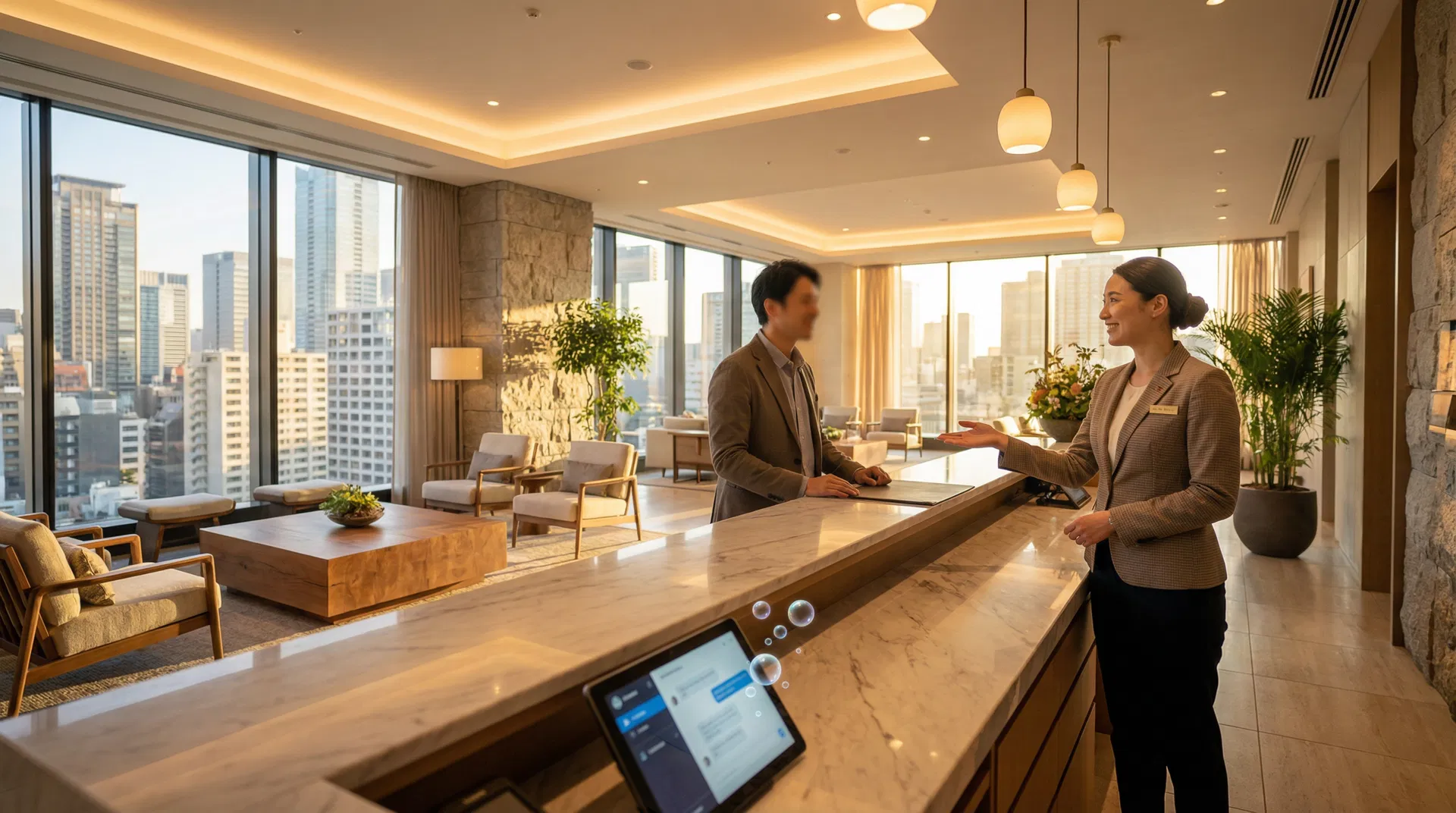
The hospitality industry is undergoing its most significant technological transformation in decades. At the center of this revolution are hotel chatbots — AI-powered conversational systems that are fundamentally reshaping how hotels interact with guests, manage operations, and drive revenue. According to the "Navigating AI" report by Canary Technologies released in March 2026, 82% of hotels plan to expand their use of AI within the next year, while 85% will allocate at least 5% of their IT budget to artificial intelligence tools. This is no longer a pilot program or an experiment — it is a structural shift that is redefining the entire hospitality value chain.
The most revealing statistic highlights a critical gap between guest expectations and reality: 58% of guests believe AI can improve their hotel stay, yet only 23% report actually receiving personalized service — despite 61% being willing to pay more for it. This disconnect represents an enormous opportunity for hotels that implement chatbots and virtual concierges strategically.
What Is a Hotel Chatbot and How Does It Work?
A hotel chatbot is an AI-powered software system that manages guest conversations through text or voice, integrating with the property's management systems (PMS, booking engine, CRM). Unlike the simple automated response systems of the past, modern hotel chatbots leverage Natural Language Processing (NLP) and advanced language models to understand context, intent, and even the emotional tone of guest requests.
The technology operates through three fundamental capabilities. First, real-time access to property systems: the chatbot can verify room availability, reservation status, active services, and property information instantly. Second, pattern recognition: the system learns from thousands of previous conversations to understand what guests actually want, not just what they type. Third, intelligent routing: the chatbot knows when to handle a request autonomously and when to escalate it to a human staff member.
Understanding the different types of chatbot technology is essential for evaluating their effectiveness. Rule-based chatbots (decision trees) function like advanced phone menus, matching keywords to predefined responses. AI-powered conversational chatbots understand natural language and improve with every interaction, delivering a 30% increase in guest satisfaction compared to keyword-based systems. Hybrid systems combine the reliability of structured responses with AI flexibility, offering the best compromise between control and natural interaction.
| Chatbot Type | Implementation Time | Best For | Key Limitation |
|---|---|---|---|
| Rule-based (Decision Tree) | 2-4 weeks | Small properties, simple needs | Rigid responses, user frustration |
| AI-Powered Conversational | 2-3 months | Complex queries, personalization | Higher upfront investment |
| Hybrid | 1-2 months | Balance of control and flexibility | Requires both scripted and AI training |
| Multi-language & Multi-channel | 3-4 months | International hotels | Complex integration with existing systems |
Measurable Impact: How Hotel Chatbots Drive Revenue and Efficiency
The numbers tell a compelling story. Analysis of results from leading global hotel chains reveals a significant impact on revenue, operational efficiency, and guest satisfaction that goes far beyond theoretical projections.
Hilton Hotels & Resorts recorded a 50% increase in direct bookings after implementing AI-based chat systems. This result is particularly significant because direct bookings eliminate OTA (Online Travel Agency) commissions, which typically range from 15% to 25% of the booking value. Hilton's chatbot, alongside the "Connie" robot concierge, handles everyday requests that normally overwhelm the front desk: Wi-Fi information, late checkout requests, and room transfers.
Choice Hotels International achieved an automation rate of 97.4% of all calls, saving nearly $2 million in support costs. David Jordan, Senior Vice President and Chief Information Security Officer at IHG Hotels & Resorts, stated: "When we're taking millions of calls every year, being able to push some of those to chatbot technology is the right thing to do for both parties. It reduces our human-to-human interaction, and therefore the workload there."
Holiday Inn Express generates an additional $1,700 per month in upselling revenue through strategic AI deployment. The system identifies the right moment and the right offer: a guest asking about late checkout might benefit from a room upgrade, while someone inquiring about breakfast hours could be interested in a dining package.
According to a study published in the CMSR Journal in July 2025, properties that implemented AI chatbots recorded a 40.6% increase in chatbot interactions, with query resolution rates improving from 90.6% to 95.5% and a significant rise in guest satisfaction scores.
| Hotel Chain | Key Result | Category |
|---|---|---|
| Hilton | +50% direct bookings | Revenue growth |
| Choice Hotels | 97.4% call automation | Operational efficiency |
| Holiday Inn Express | +$1,700/month upselling | Incremental revenue |
| Ritz-Carlton San Francisco | -20% room cleaning time | Operational efficiency |
| Four Seasons (Papagayo) | -50% food waste | Cost reduction |
Guest Perception: Why Instant Response Changes Everything
The single most important factor determining the success of a hotel chatbot is response speed. In an era where consumers are accustomed to the immediacy of Amazon, Uber, and messaging apps, waiting for a hotel response represents a critical friction point in the customer journey.
The data is unequivocal: 70% of guests expect messaging options during their hotel stay, while 85% of consumers want to be able to text with businesses, including hotels. AI chatbots respond on average in under 2 minutes, handling up to 70% of inquiries instantly, compared to wait times that can exceed 15-20 minutes during peak periods at traditional properties.
The psychological impact of instant response on guest perception is profound and multidimensional. When a guest receives an immediate answer to their request — whether it is an extra towel, restaurant information, or a reservation modification — it triggers a mechanism of instant gratification that positively influences the entire perception of their stay. Academic research confirms that response speed is the single factor most correlated with overall guest satisfaction, surpassing even room quality or hotel location in terms of the likelihood of leaving a positive review.
Properties using chatbots for feedback collection have achieved extraordinary results. According to Master of Code, integrating chatbots for review collection has led to response rate increases from 19% to as much as 300%. This figure is revolutionary: traditional post-stay feedback emails have an average response rate of just 8%, while chatbots, by interacting with guests in real time during their stay, capture feedback when the experience is still fresh and engagement is at its peak.
A case study reported by TheCrunch.io demonstrates how one property achieved a 90% guest engagement rate with the chatbot, a 42% reduction in calls to the concierge desk, and a 25% increase in spa bookings through contextual chatbot suggestions. These numbers demonstrate that guests not only accept AI interaction but actually prefer it when well implemented.
Innovative Hotels: How Industry Leaders Are Implementing AI
AI adoption in hospitality is no longer limited to large international chains. The BCG report "AI-First Hotels: Leaner, Faster, Smarter" published in March 2026 identifies three macro-transformations reshaping the sector.
The first transformation involves commercial and customer experience excellence at scale. Multilingual AI concierges — from Hilton's "Connie" robot to Marriott's text-based chatbots — handle everyday requests that overwhelm front desk staff. According to a Statista report cited by BCG, 65% of global travel leaders believe the most impactful implementation of GenAI relates to chatbots, virtual device assistants, and customer service. These systems are more than just an added convenience: they allow customer support teams to deliver the human touch experiences — solving more complex challenges and finding opportunities to delight — that can differentiate a brand.
The second transformation addresses cost and workforce optimization. The hospitality industry faces an unprecedented staffing crisis: in North America alone, 65% of hotels reported staffing shortages in 2025, according to the American Hotel & Lodging Association, while labor costs have jumped 11.2% year-over-year. In this context, the Ritz-Carlton San Francisco implemented an AI system that synchronizes room-cleaning schedules with check-out patterns, guest preferences, and staff availability, reducing room preparation time by 20%.
The third transformation involves robotic automation. Robots can restock minibars, deliver towels, transfer luggage, and clean common spaces, orchestrated by agentic AI that sequences deliveries, reroutes around obstacles, and resolves issues in real time. Hotels using systems like Relay integrate autonomous delivery devices with property management and elevator systems to deliver amenities, food and beverage, and linens directly to guest rooms.
AI-Enhanced Feedback: Turning Guest Opinions into Competitive Advantage
Feedback management represents one of the areas where chatbots are generating the most significant value. Traditionally, hotel feedback collection relied on paper questionnaires in rooms, post-stay emails, or telephone surveys — all methods with low response rates and often delayed, difficult-to-action feedback.
AI chatbots have radically transformed this paradigm. By engaging with guests during their stay rather than after, chatbots capture feedback while the experience is still in progress, enabling the property to intervene immediately to resolve any issues. This proactive approach delivers a dual benefit: it improves the guest experience in real time and prevents negative post-stay reviews.
AI systems for review management have demonstrated a measurable impact on hotels' online reputation. TrustYou has documented how AI review responses are generated in 30 seconds, compared to 4 minutes required for a manual response. This speed allows hotels to respond to a significantly higher volume of reviews, improving the overall response rate — a factor that algorithms on platforms like TripAdvisor, Google, and Booking.com consider in property rankings.
The virtuous cycle is clear: chatbots collecting real-time feedback, immediate intervention on issues, improved experience, more positive reviews, higher platform rankings, more bookings, increased revenue. According to Myma.ai data, hotels using AI chatbots see a 20-35% increase in direct booking conversion rates compared to static web forms.
Generative Engine Optimization: How Hotels Can Get Cited by AI
Optimization for generative search engines — known as GEO (Generative Engine Optimization) — represents the new frontier of digital visibility for hotels. With the rise of ChatGPT, Perplexity, Gemini, and other AI assistants, a growing share of travel-related searches is conducted through conversational interfaces rather than traditional Google search.
The fundamental difference between SEO and GEO lies in how content is selected and presented. While Google ranks web pages based on links, authority, and keyword relevance, generative language models select information to cite based on structural clarity, source authority, the presence of verifiable quantitative data, and the content's ability to directly answer specific questions.
For hotels seeking to be cited by AI when a user asks "what are the best hotel chatbots" or "how is AI changing hospitality," it is essential to adopt a content strategy that includes statistical data with verifiable sources, clear structure with hierarchical headings, explicit definitions of key concepts, comparative tables for organizing information, and FAQ sections that directly answer the most common questions.
The Future of Hotel Chatbots: Trends 2026-2030
The future of hotel chatbots is moving along clear trajectories that are already taking shape in the world's most innovative properties.
Agentic AI represents the most significant evolution. Unlike current chatbots that respond to questions, AI agents can execute complex actions autonomously: booking a restaurant, arranging a transfer, modifying a reservation, and coordinating multiple services in a single conversation. This evolution will transform the chatbot from a support tool into a truly autonomous digital concierge.
Predictive hyper-personalization will use guests' historical data, expressed preferences, and behavioral patterns to anticipate needs before they are even expressed. A regular guest who always arrives on Friday evening and always orders a bottle of wine in the room will find their preferred wine already waiting upon arrival, thanks to AI that has learned their habits.
Voice integration will take chatbots beyond the screen. Voice assistants in hotel rooms, integrated with the property's systems, will allow guests to control lighting, temperature, order room service, and request information simply by speaking, in any language.
Real-time sentiment analysis will enable chatbots to detect frustration, dissatisfaction, or enthusiasm in the tone of conversations, automatically adapting the response style or escalating to a human operator when necessary.
Conclusion: AI Does Not Replace Hospitality — It Amplifies It
The most important lesson emerging from the data and case studies is that hotel chatbots are not designed to replace human interaction but to amplify it. The properties achieving the best results are those using AI to handle predictable, transactional requests — availability, information, standard services — freeing staff to focus on interactions that require empathy, creativity, and human judgment.
With 82% of hotels planning to expand AI use in the coming year and documented results including 50% increases in direct bookings, millions of dollars in operational savings, and significant improvements in guest satisfaction, the question is no longer whether to implement a chatbot, but how quickly to do so.
The future of hospitality belongs to properties that can combine the most advanced technology with the most authentic human touch. Chatbots are the tool that makes this synthesis possible.
FAQ — Frequently Asked Questions About Hotel Chatbots
What is a hotel chatbot?
A hotel chatbot is an AI-powered software system that manages guest conversations through text or voice, answering questions, managing reservations, collecting feedback, and providing property information automatically and instantly, 24 hours a day, 7 days a week.
How much does it cost to implement a chatbot in a hotel?
Costs vary significantly by type. A rule-based chatbot can be implemented in 2-4 weeks at relatively low cost, while a full AI conversational system requires 2-3 months and a higher initial investment. ROI is typically positive within 6-12 months due to operational savings and revenue increases.
Can chatbots really improve guest satisfaction?
Yes, the data confirms it. AI conversational chatbots deliver a 30% satisfaction increase compared to traditional systems. 70% of guests expect messaging options during their stay, and properties with chatbots report 35% faster request resolution times.
Which hotels are already using chatbots successfully?
Hilton (direct bookings +50%), Choice Hotels (97.4% call automation), Holiday Inn Express (+$1,700/month upselling), IHG, Marriott, Four Seasons, and Ritz-Carlton are among the chains that have implemented AI chatbots with documented results.
Will chatbots replace hotel staff?
No. Data shows that the most successful implementations use a hybrid approach: chatbots handle predictable requests (70-97% of volume), while human staff focus on complex interactions requiring empathy and judgment. Choice Hotels, for example, automates 97.4% of calls but maintains its guest service team for the remaining 2.6%.
How can chatbots increase hotel revenue?
Chatbots increase revenue in three primary ways: boosting direct bookings (eliminating OTA commissions), generating contextual upselling (upgrades, spa, dining), and improving conversion rates by 20-35% compared to static web forms.
What is Generative Engine Optimization (GEO) for hotels?
GEO is the strategy of optimizing content to be cited and referenced by AI-based search engines like ChatGPT, Perplexity, and Gemini. For hotels, this means creating structured content rich in verifiable data and organized to directly answer user questions.
Sources: Canary Technologies (2026), NectarInnovations (2026), Boston Consulting Group (2026), CMSR Journal (2025), HelloShift (2026), Airmeez (2025), Master of Code, TheCrunch.io, TrustYou, Myma.ai (2026), Search Engine Land (2026).