By 2030, Only Hotels with a Strong Identity Will Survive: How to Build a Recognizable Brand in the Age of Differentiation
The hotel industry is entering a phase of profound transformation. With thousands of similar hotels competing for attention, only properties capable of building a strong identity, authentic storytelling, and memorable experiences will survive the competition of 2030.
Hotel Marketing
World Hotel Journal Editorial
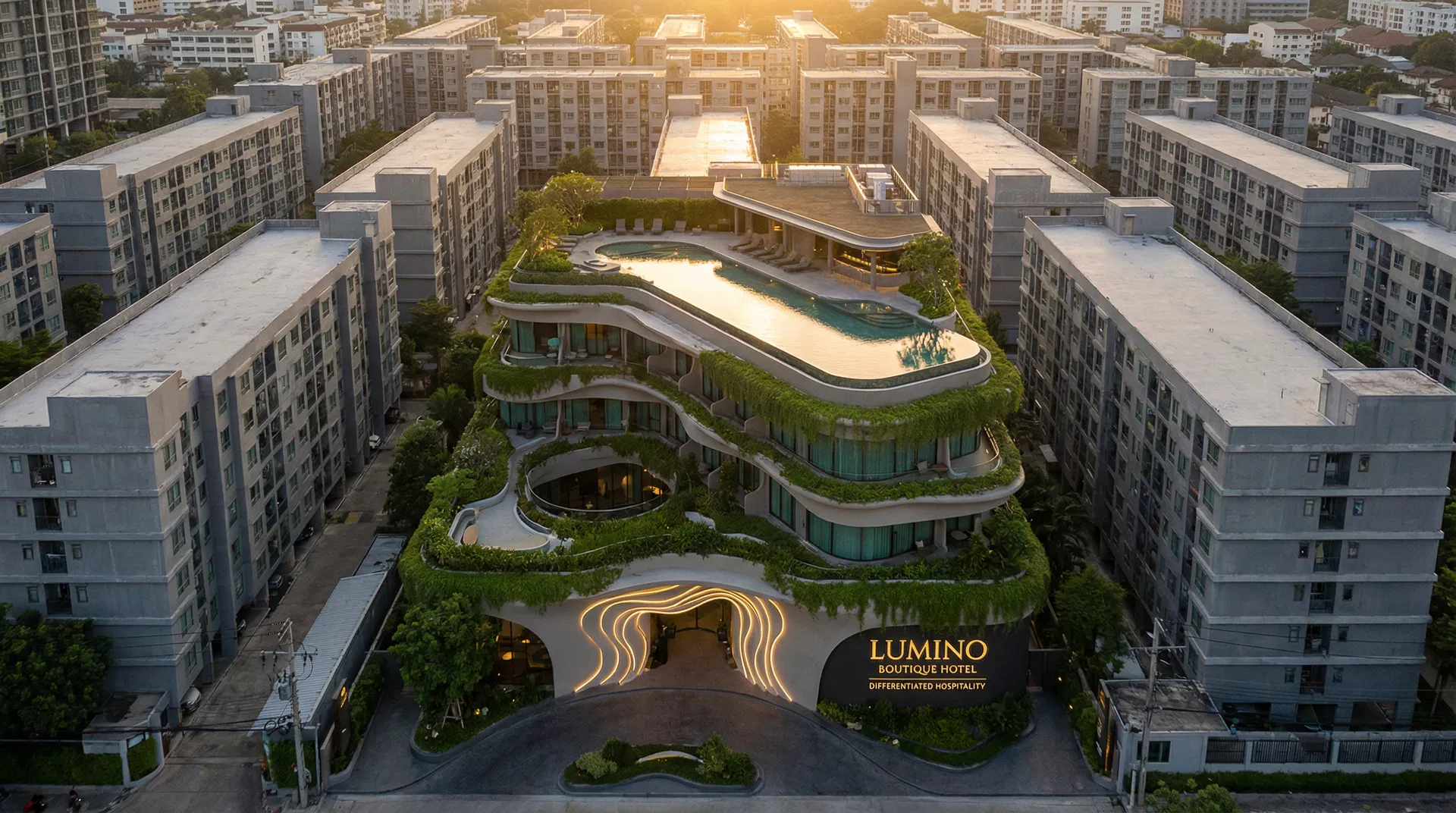
## The Great Paradox of Modern Hospitality
The global hotel industry is experiencing an unprecedented paradox. Over the past twenty years, the number of accommodation properties has grown exponentially: according to STR Global data, in 2025 the world counts over 17.5 million hotel rooms, a 22% increase compared to 2015. Yet, despite this impressive growth, traveller behaviour has changed radically. Today the problem is no longer finding a hotel. The problem is choosing among thousands of hotels that look dangerously alike.
This phenomenon has a precise name in the world of hotel marketing: the **invisible hotel syndrome**. Similar rooms. Similar services. Similar communication. For the guest, one hotel is as good as another. And when this happens, the only factor remaining in the decision becomes price. Competing exclusively on price is one of the most dangerous strategies for any hotel property, because it erodes margins, devalues the product, and triggers a downward spiral from which it is extremely difficult to escape.
According to a McKinsey & Company analysis of the hospitality sector, hotels that compete primarily on price record operating margins 35-40% lower than those that have built a strong brand identity. The European luxury hotel market, which according to Mordor Intelligence will reach 33 billion dollars in 2026, increasingly rewards properties capable of offering a distinctive and recognizable experience.
## The New Psychology of the Contemporary Traveller
The 2026 traveller no longer seeks merely a place to sleep. They seek a **recognizable experience**, a narrative in which to identify themselves, a precise reason to choose one property over another. This transformation is deep and structural, driven by several converging factors.
First, the **democratization of travel** has made the hotel experience accessible to a vast audience. Online booking platforms such as Booking.com, Expedia, and Airbnb have eliminated information barriers: guests can compare dozens of properties in seconds, read thousands of reviews, and make decisions based on concrete data. In this scenario, the hotel that fails to clearly communicate what makes it different simply becomes another line in an endless list.
Second, **Millennial and Gen Z generations**, who will represent over 60% of global travellers by 2030 according to a Skift Research report, place enormous value on the authenticity and personality of experiences. They don't want generic hotels: they want properties with a story, a philosophy, a worldview. They want to be able to say: "I chose that hotel for a specific reason."
Finally, the phenomenon of **hotel hopping** — the tendency to stay at multiple different hotels during the same trip — is growing rapidly. Travellers seek diverse and complementary experiences, and they reward properties that offer something unique and unrepeatable. According to Hospitality Net, this trend is particularly pronounced in the luxury segment, where guests are willing to pay a significant premium for an experience that tells a story.
## The Five Pillars of Hotel Identity
The hotels that perform best in today's global market are those that have built a true identity around one or more fundamental pillars. These are not simple commercial categories, but **operational philosophies** that permeate every aspect of the guest experience.
The first pillar is **design as an identity language**. Hotels such as the Bulgari Milan, the Aman Tokyo, or the recent 1 Hotel Tokyo have made architectural and interior design their defining trait. This is not about decoration, but about a coherent aesthetic vision that communicates values, culture, and aspirations. According to an analysis by Hospitality ON published in February 2026, design is becoming "the new structuring asset of brand equity" in the hotel sector, transforming from a decorative element into a strategic tool for value creation.
The second pillar is **immersion in nature and territory**. Properties such as Six Senses Bhutan, Soneva Fushi in the Maldives, or Lefay Resort on Lake Garda have built their identity around a deep relationship with the surrounding environment. The concept of "sense of place," extensively studied by EHL Hospitality Business School, represents today one of the most powerful differentiators in the luxury segment. The hotel is no longer a neutral container: it becomes an extension of the landscape, a bridge between the guest and the territory.
The third pillar is **gastronomy as a cultural experience**. Hotels like Borgo Egnazia in Puglia or the Mandarin Oriental Bangkok have transformed dining into a central element of their identity. It's not simply about having a good restaurant, but about creating a gastronomic journey that tells the story of the territory, traditions, and the chef's creativity. Data shows that immersive culinary experiences, rooted in local interactions, are becoming increasingly important in hotel selection.
The fourth pillar is **holistic wellness**. The global wellness economy has surpassed 5.6 trillion dollars according to the Global Wellness Institute, and hotels that have integrated wellness into their identity — not as an additional service but as a founding philosophy — are recording occupancy rates and average rates significantly above market averages. Properties like SHA Wellness Clinic in Spain or Lanserhof in Austria have demonstrated that wellness can be the beating heart of a hotel identity.
The fifth pillar is **connection with the local community**. The most innovative hotels are abandoning the "tourist bubble" model to become cultural hubs open to the territory. According to Hospitality Net, mixed-use developments that integrate hospitality, retail, and culture are creating "living landscapes where guests and residents connect through shared spaces." The hotel becomes a meeting point between travellers and the local community, enriching the experience of both.
## The Transformative Power of Storytelling
In a market saturated with similar offerings, storytelling has become the most powerful weapon for differentiation. The hotels that grow the most are often those that have learned to **tell their story** authentically and engagingly. They don't simply sell rooms: they narrate the building's history, the connection to the territory, the philosophy of hospitality, the experience the guest will live.
An emblematic example is the phenomenon of **adaptive reuse** — the conversion of historic buildings into hotels. Former post offices, decommissioned factories, railway stations, courthouses: these buildings arrive with built-in texture and credibility. As highlighted by a Hospitality Net analysis from March 2026, "historic hotel conversions command higher rates because travellers value the authenticity of tall ceilings, exposed brickwork, and original architectural details." The building's past becomes part of the guest experience, and the hotel's role transforms: from simple accommodation to curator and narrator of a story.
Storytelling transforms a property from a simple hotel into a **destination**. Capella Kyoto, opening in 2026 in the historic Miyagawa-cho district, is a perfect example: the Capella Curate programme offers immersive cultural experiences, from visits to a 150-year-old atelier producing traditional wooden sandals to intimate maiko performances. This attention to hyper-local storytelling represents the future of hospitality, where luxury is no longer synonymous with global uniformity but with authenticity rooted in territory.
Sensory branding represents another frontier of hotel storytelling. As Martin Lindstrom, a world expert in sensory branding, emphasizes, the most memorable brands are those that engage all the senses. A hotel's characteristic scent, the texture of fabrics, the soundtrack of common areas: every sensory element contributes to creating a unique and memorable identity. Chains like DoubleTree by Hilton have built entire identity rituals around a single sensory element — the famous warm cookie offered at check-in — demonstrating that even seemingly small details can become powerful identity markers.
## The Era of Digital Differentiation
Booking platforms have made the market extremely competitive, but they have also created new opportunities for hotels capable of differentiating themselves. On portals like Booking.com or Airbnb, guests compare dozens of properties in seconds. In this scenario, only hotels that can clearly communicate what makes them different emerge.
**Technology** plays a crucial role in this differentiation. It's not about adopting technology for the sake of being "innovative," but about using it as a tool to amplify the hotel's identity. An AI concierge that knows the guest's preferences and suggests personalized experiences strengthens the identity of a service-oriented hotel. A smart room system that automatically adjusts lighting, temperature, and music based on the guest's profile amplifies the identity of a wellness-focused hotel.
According to the Grand View Research report, the global luxury travel market will reach 2.3 trillion dollars by 2030, with an annual growth rate of 7.8%. In this expanding market, technological differentiation will be increasingly important, but only if coherently integrated into the property's overall identity.
**Social media** represent another fundamental battleground. Hotels with a strong identity generate organic content through their guests: photos, videos, stories that tell a unique experience. This user-generated content is infinitely more effective than any advertising campaign because it is authentic, credible, and viral. "Instagrammable" hotels are not those with the most flashy decorations, but those with the most coherent and recognizable identity.
## The Future of Hospitality: Who Will Survive in 2030?
By 2030, the hotel market will likely be even more competitive than today. Artificial intelligence will make it easier for guests to compare and filter options. Booking platforms will become even more sophisticated. And travellers will be even more demanding and informed.
In this scenario, many generic hotels will struggle to stand out and will be forced to compete in a price war that will progressively erode their margins. Those that will grow will instead be those capable of building three fundamental elements: a **strong identity**, **clear communication**, and a **memorable experience**.
Strong identity means having a clear vision of who you are, what you offer, and why you exist. It's not enough to have beautiful rooms and good service: you need a raison d'être that goes beyond the accommodation function. Clear communication means being able to translate this identity into coherent messages across all channels, from the website to social media, from the reception to follow-up emails. Memorable experience means transforming every touchpoint of the customer journey into a moment that reinforces the hotel's identity and creates an indelible memory in the guest.
## Strategic Recommendations for Hoteliers
For hotel operators who want to prepare for 2030, several concrete strategic recommendations emerge.
**First: conduct an identity audit.** Ask yourself honestly: if we removed the logo from the facade, would our guests still recognize our hotel? If the answer is no, you have an identity problem that needs to be addressed urgently.
**Second: invest in storytelling.** Every hotel has a story to tell. It could be the story of the building, the founder, the territory, the culinary philosophy, or the relationship with the local community. Find your story and tell it consistently across all channels.
**Third: create identity rituals.** Rituals are powerful identity markers. A signature welcome drink, a distinctive scent, a symbolic object in the room: these seemingly small elements create lasting memories and differentiate the experience in tangible ways.
**Fourth: embrace technology as an identity amplifier.** Don't adopt technology to follow a trend, but to strengthen what makes you unique. If your identity is tied to wellness, invest in technologies that enhance the wellness experience. If it's tied to the territory, use technology to connect guests with local culture.
**Fifth: measure and iterate.** Identity is not a one-time project but a continuous process. Monitor how guests perceive your brand through reviews, surveys, and social listening. Adapt your strategy based on feedback, always maintaining consistency with your founding vision.
## Conclusion: The Most Recognizable Hotel Will Win
The future of hospitality does not necessarily belong to the largest hotel, the most luxurious, or the most technological. It belongs to the most **recognizable** one. The one that has built an identity so strong and coherent that it becomes a destination in itself, not simply a place to sleep.
In the tourism world of 2030, where supply will be overabundant and competition fierce, identity will be the true luxury. Not the marble in the lobbies, not the thread count of the sheets, not the number of stars on the facade. But the ability to make every guest feel part of a unique, authentic, and unrepeatable story.
Hotels that understand this shift and act now will have an enormous competitive advantage. Those that continue to compete on service parity and price risk becoming, by 2030, yet another invisible hotel in a sea of identical options.
The question every hotelier should ask themselves today is simple but fundamental: **what is the story my hotel tells?** And above all: **is it a story worth choosing?**